
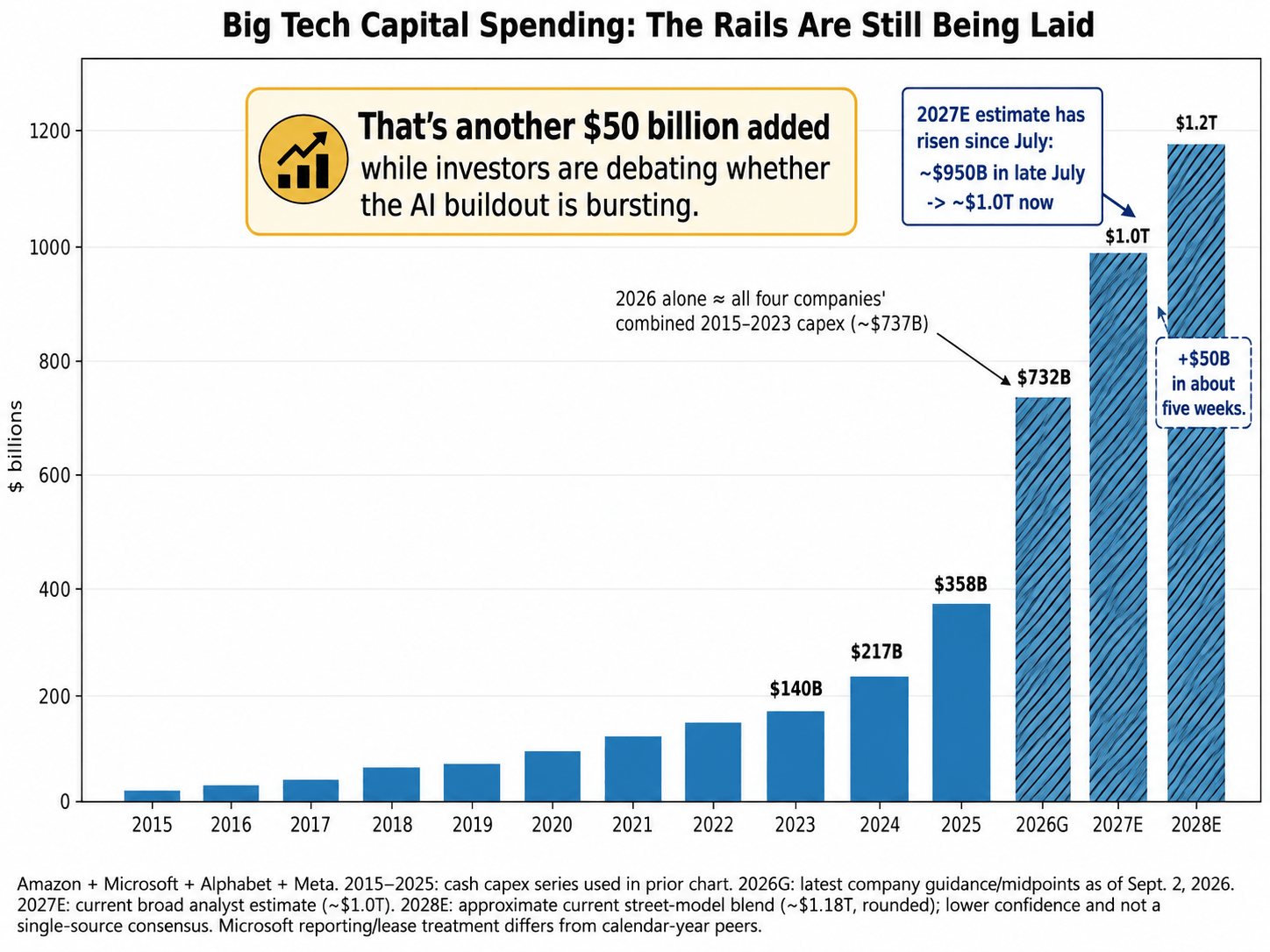
“AI bubble” is being screamed from a lot of directions right now. I think many are looking at the trees and missing the whole forest.
Forget 2000 dot-com, think 1878.
America had already connected the continent by rail. Fortunes were made and lost. Leaders changed constantly. Some railroad companies disappeared altogether. But the tracks kept getting laid. And look at what followed: empires in steel, banking, hotels, national retailing, mail systems, new cities, and businesses nobody could fully envision when the rails were first being driven west.
The first fortunes were made laying track. The bigger opportunity came from everything the tracks made possible. A year ago I compared the scale of the AI infrastructure-buildout to rebuilding Europe after World War II. Now seems to me the westward railroad expansion is the better comparison – only now it’s global, and much faster. And while cries of AI bubble ring out, the spending estimates keep going the other way. And while cries of “AI bubble” ring out, spending estimates keep going the other way. Since late July alone, 2027 capex estimates for Amazon, Microsoft, Alphabet and Meta have risen another $50 billion.
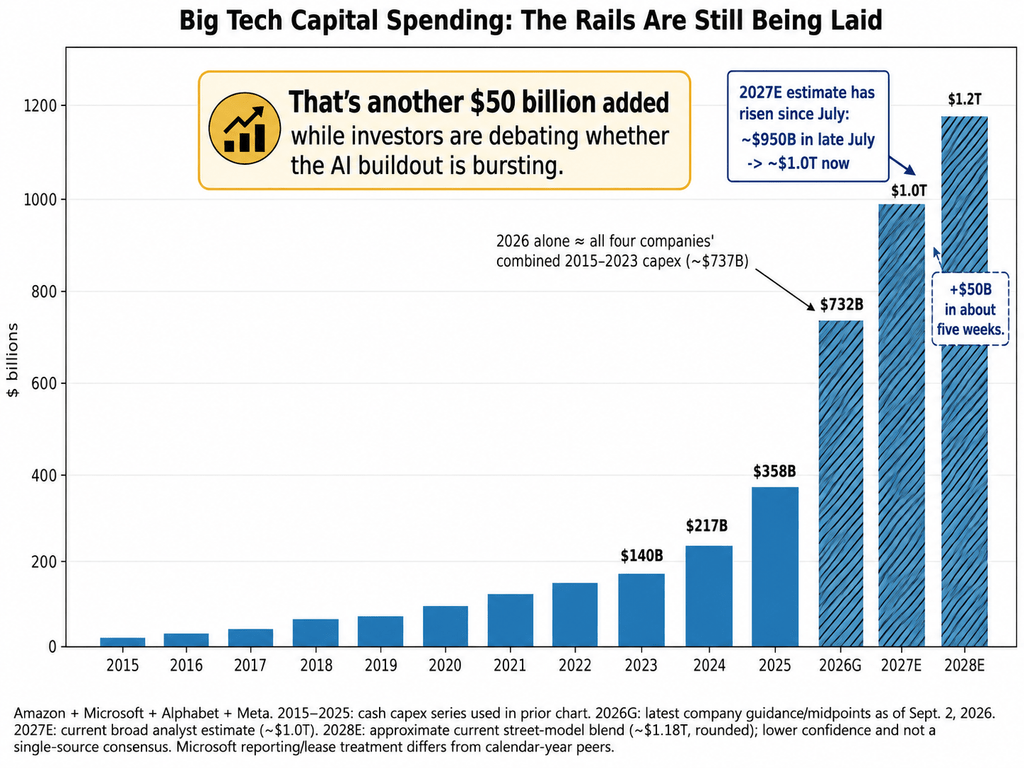
We aren’t watching an AI bubble burst. We are watching the rails being laid while the market tries to figure out who owns the best property and ideas along the next stretch of track.
I would not be surprised by another swift selloff before the U.S. midterms. Rates, geopolitics, election uncertainty and huge gains give investors plenty of reasons to shoot first and ask questions later. Nor would I be surprised by a violent rally afterward. The June-July rebound happened so fast many folks missed it. Big transitions overshoot in both directions.
And AI itself is transitioning. Phase One was mostly about building the intelligence – training bigger and better models. We are now entering Phase Two: inference—putting that intelligence to work through reasoning and agents. I believe this could unfold through five, six, or seven phases. That transition is creating tremendous tumult underneath the market. Spending is shifting. Business mixes are changing. Analysts are trying to measure new economics with old yardsticks. Too many investors are still focused on Phase One and have not positioned for Phase Two. So, when a technology company reports great earnings and outlook, then the stock gets crushed the next day, I do not automatically conclude the bubble burst. Sometimes expectations were too high. Sometimes valuation got ahead of reality. But increasingly I think we are watching the market sort the next winners.
The market isn’t abandoning AI. It’s sorting who may own the next stretch of track—and what becomes possible because the rails exist: networking, memory, power, cooling, cybersecurity, data transmission, agents, robotics and industries that may not even have names yet. There will absolutely be pockets of excess. Some companies will fail. Some stocks will become ridiculously expensive. Leadership will change—probably many times. That happened with the railroads too.
I continue to encourage you during market sell-offs to remember the enormous AI opportunity I believe continues to lie ahead and “shop during the sale” for long-term opportunities as I’ve written in prior Updates. The volatility may be uncomfortable. The opportunity may be historic. The rails are still being laid.
Image created using AI-assisted digital artwork directed by Clint Gharib. Opinions expressed are that of the author and are not endorsed by the named broker/dealer or its affiliates. All information herein has been prepared solely for informational purposes and should not be considered legal or tax advice. It is not an offer to buy, sell, or a solicitation of an offer to buy or sell any security or instrument to participate in any particular trading strategy and is not intended to provide, & should not be relied on for, tax, legal or accounting advice. You should consult your own tax professional regarding your specific situation. Past performance does not guarantee future results. Certain statements contained within are forward-looking statements including, but not limited to, statements that are predictions of future events, trends, plans or objectives. Undue reliance should not be placed on such statements because, by their nature, they are subject to known and unknown risks and uncertainties. Oxford Retirement Advisors is an independent firm with Securities and Advisory services offered through Madison Avenue Securities, LLC (“MAS”), member FINRA/SIPC and a Registered Investment Advisor. Oxford Retirement Advisors and MAS are not affiliated entities